
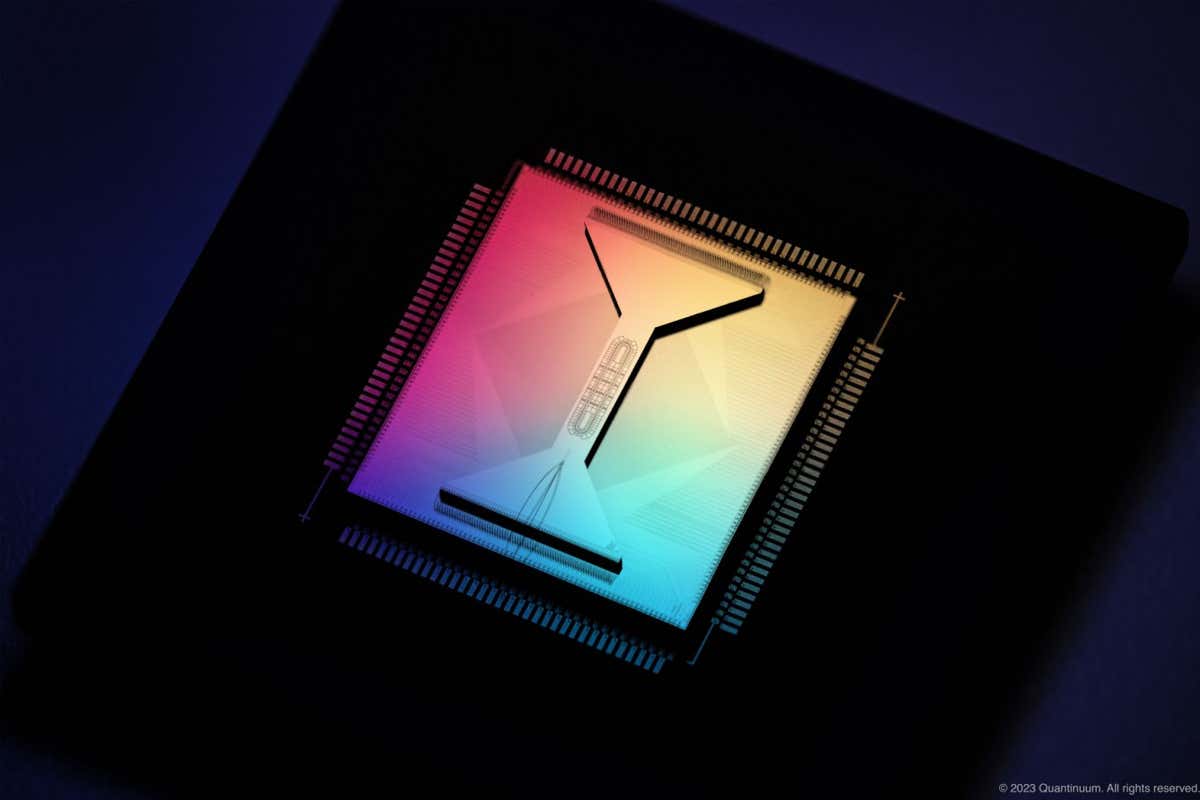
The Quantinuum H2 chip
How many
Microsoft and quantum computing company Quantinuum claim to have made a quantum computer that has an unprecedented level of reliability. Its ability to correct its own errors could be a step toward more practical quantum computers in the near future.
“What we did here gives me goosebumps. “We have shown that bug fixes are repeatable, workable, and reliable,” says Krysta Svore of Microsoft.
Experts have long anticipated the arrival of practical quantum computers, which could perform calculations too complex for conventional computers. Although quantum computers are becoming larger and more complex, this prediction has not yet been fully realized. A big reason for this is that all contemporary quantum computers make errors, and researchers have found it technically difficult to implement algorithms to detect and correct them during calculation.
The new experiment may represent a significant step toward overcoming this error problem: The researchers say they ran more than 14,000 separate computational routines on Quantinuum’s H2 quantum processors without a single error.
Classical computers also make errors, but error correction can be coded into programs by making backup copies of the information being processed. This approach is not possible in quantum computing because quantum information cannot be copied. So instead, the researchers distributed it into groups of connected quantum bits, or qubits, to create what are known as logical qubits. The Microsoft and Quantinuum team used 30 qubits to create four of these logical qubits.
Svore says it was the generation of these logical qubits, using a process developed by Microsoft, that enabled repeated error-free or fault-tolerant runs of experiments. Individual qubits are often easily altered, but at the level of logical qubits, the researchers were able to repeatedly detect and correct errors.
They say this approach was so successful that the four logical qubits produced just 0.125 percent of the errors seen when the 30 qubits were left unclustered. This means that the unclustered qubits would have produced up to 800 errors for every error produced by the logical qubits.
“A logical error rate 800 times lower than the error rate of physical qubits is a very significant advance in the field that brings us one step closer to fault-tolerant quantum computing,” says Mark Saffman of the University of Wisconsin, who did not participate. with the experiment.
Quantinuum’s Jennifer Strabley says the team’s hardware was well suited for the new experiments because it offers a high degree of control over the qubits and because its quantum computer already had some of the lowest error rates achieved to date.
In 2023, a team of researchers from Harvard University and their colleagues, including some from the quantum computing startup QuEra, broke the record for the largest number of logical qubits: 48 at a time. This is much more than the four logical qubits of the new device. But Strabley says the new device requires fewer physical qubits per logical qubit, and the logical qubits made fewer errors than those built by the Harvard team. “We used much fewer physical qubits and got better results,” he says.
However, some experts consulted by new scientist They were not yet prepared to call the new work a breakthrough in quantum error correction without more details about the experiment.
It is generally accepted that only quantum computers with 100 or more logical qubits will be able to truly address scientifically and socially relevant problems in areas such as chemistry or materials science. The next challenge is to make everything bigger. Both Strabley and Svore say they are confident that the long-standing collaboration between Microsoft and Quantinuum is coming soon.
Topics:
- futurology/
- quantum computing
#Microsoft #Quantinuums #quantum #computer #reliable