
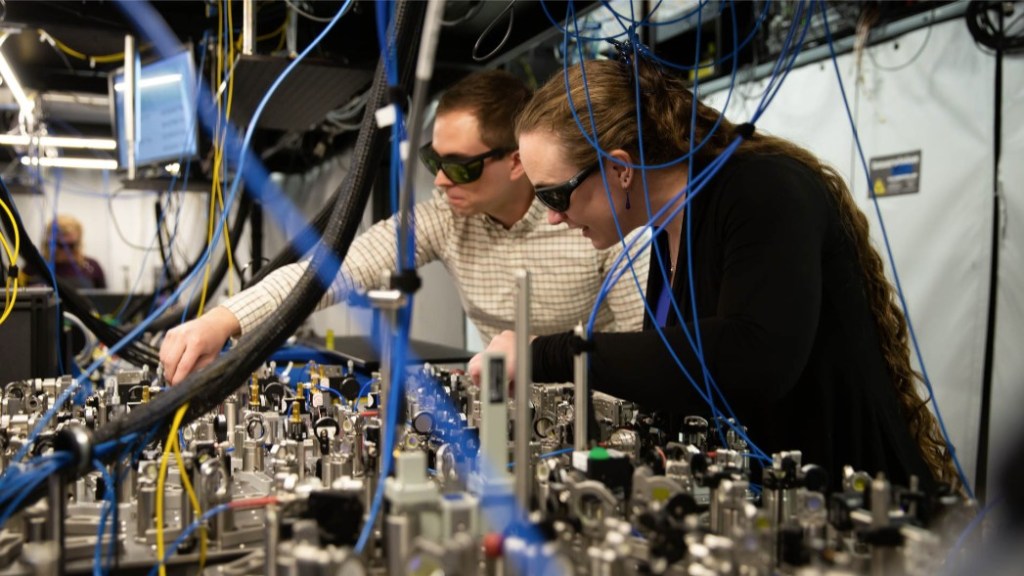

Image credits: microsoft
Microsoft and Quantinuum today announced a breakthrough in quantum error correction. Using Quantinuum’s ion trap hardware and Microsoft’s new qubit virtualization system, the team was able to run more than 14,000 experiments without a single error. This new system also allowed the team to verify the logical qubits and correct any errors they found without destroying the logical qubits.
This, the two companies say, has moved the state of the art in quantum computing out of what has typically been called the era of noisy intermediate-scale quantum computers (NISQ). “Noisy” because even the smallest changes in the environment can cause a quantum system to become essentially random (or “decohere”), and “intermediate scale” because the current generation of quantum computers is still limited to just over a thousand qubits. in the best case. . A qubit is the fundamental unit of computation in quantum systems, analogous to a bit in a classical computer, but each qubit can be in multiple states at the same time and does not fall into a specific position until it is measured, which underlies the potential from Quantum to deliver a huge leap in computing power.
However, it doesn’t matter how many qubits you have if you barely have time to run a basic algorithm before the system becomes too noisy to get a useful result, or any result at all.
By combining several different techniques, the team was able to run thousands of experiments with virtually no errors. That involved quite a bit of preparation and pre-selection of systems that already seemed to be in good shape for successful execution, but still, it’s a huge improvement over where the industry was just a short time ago.
It’s a step in the right direction for quantum computing. There are still many problems to be solved (and these results also need to be replicated, of course), but theoretically, a computer with 100 of these logical qubits could already be useful in solving some problems, while a machine with 1,000 qubits could, says Microsoft, “unlock a commercial advantage.”


Discrepancies (errors) between entangled qubits. Discrepancies are revealed by comparing the images of each qubit in a pair, and any differences that exist appear as dots on the central image between each pair. Image credits: microsoft
The team used Quantinuum’s H2 trapped ion processor and was able to combine 30 physical qubits into four highly reliable logical qubits. Encoding multiple physical qubits into a single logical qubit helps protect the system from errors. Physical qubits are entangled so that an error in a physical qubit can be detected and corrected.
It is this error correction that has long bothered the industry: the lower the noise and the higher the quality of the physical qubits, the better, of course, but without sophisticated error correction, there is no way out of the situation. It was NISQ because these systems all decohere sooner rather than later.
“Simply increasing the number of physical qubits with a high error rate, without improving that error rate, is useless because doing so would result in a large quantum computer that is no more powerful than before,” said Dennis Tom, general manager of Azure. . Quantum and Krysta Svore, vice president of advanced quantum development at Microsoft, wrote in today’s announcement. “In contrast, when physical qubits with sufficient performance quality are used with a specialized orchestration and diagnostic system to enable virtual qubits, only then does increasing the number of physical qubits result in powerful, fault-tolerant quantum computers capable of operating for longer. , more complex calculation.”
It was only a couple of years ago that logical qubits began to outperform physical qubits. Now, Microsoft and Quantinuum argue that their new hardware/software system demonstrates the largest gap between physical and logical error rates, improving the use of physical qubits alone by up to 800 times.


Image credits: microsoft
The researchers note that to go beyond NISQ, a large separation between the error rates of logical and physical qubits is necessary, as is the ability to correct individual circuit errors and generate entanglements between at least two logical qubits. If these results hold, then the team achieved all three and we have effectively entered a stable era The era of resilient quantum computing.
It turns out that the most important result here may actually be the team’s ability to perform “active syndrome extraction” – that is, the ability to diagnose an error and correct it, without destroying the logical qubit in the process.
“This achievement marks the first step in being able to correct errors without destroying logical qubits and shows a fundamental milestone in quantum error correction,” explain Tom and Svore. “We demonstrated this critical component of reliable quantum computing with our qubit virtualization system, resulting in a low logic error rate across multiple rounds of syndrome extraction.”
It will now be up to the rest of the quantum community to replicate these results and implement similar error correction systems. Although it’s probably just a matter of time.
“Today’s results mark a historic achievement and are a wonderful reflection of how this collaboration continues to push the boundaries of the quantum ecosystem,” said Ilyas Khan, founder and chief product officer of Quantinuum. “With Microsoft’s next-generation error correction aligned with the world’s most powerful quantum computer and a fully integrated approach, we are very excited about the next evolution in quantum applications and can’t wait to see how our customers and partners will do.” . benefit from our solutions, especially as we move toward quantum processors at scale.”
For more details, you can find the white paper here.
#Microsoft #Quantinuum #ushered #era #quantum #computing #TechCrunch