
New semiconductors are needed
The importance of the semiconductor industry has been growing steadily in recent decades, moving from industrial mainframe computers to an essential part of virtually all current machines and devices.
This growth has been driven by the increasing complexity and miniaturization of semiconductors. However, due to the fundamental physical properties of silicon, silicon-based semiconductors are starting to reach some limits.
Fortunately, silicon is far from the only material that shows semiconducting properties, that is, the ability to go from a state in which it functions as an insulator (does not allow electricity to flow) to a conductor (allows electricity to flow).
New research reveals new insights into the fundamental physics of innovative semiconductor materials such as vanadium dioxide and the previously unsuspected semiconductor properties of titanium dioxide.
The research was conducted through a multidisciplinary research effort conducted by researchers from Pennsylvania State University, Cornell University, Argonne National Laboratory, Georgia Institute of Technology, and the Paul Drude Institute for Solid State Electronics. of Germany in Berlin.
Vanadium and Moore’s law
What makes vanadium dioxide a prime candidate for new semiconductor technology is vanadium’s ability to switch between metal (the “1” state) and insulator (the “0” state) in just one minute. billionth of a second.
This is a phenomenon known as “metal-insulator transitions.” The speed of the metal-insulator transition should allow for faster and smaller electronics compared to classical silicon-based electronics.
This is essential if we want the semiconductor industry to keep up with Moore’s Law.
Formulated in 1965, Moore’s Law is the empirical law according to which the semiconductor industry increases the number of transistors on a chip by 100% every two years. This has remained true for decades since, but the fundamental limits of silicon chips mean that new types of materials will soon be needed to keep it that way.
Moore’s Law is an application to the semiconductor industry of Wright’s Law of 1936, which states that manufacturing costs will be reduced by up to 15% for each doubling of production (initially developed for the aircraft industry).
Wright’s law is more of a rule about economies of scale and industrial efficiency when increasing production. Meanwhile, Moore’s Law is more about technological innovation and is driven by progress in understanding fundamental physics and engineering at the nanometer scale.
New insights
Advanced methods
Until now, vanadium dioxide has only been analyzed and observed as an isolated component. While useful, this limited the understanding of what would actually happen in a vanadium dioxide-based semiconductor.
In his publication in Advanced Materials (“Running spatiotemporal imaging of coupled film substrate elastodynamics during an insulator-to-metal transition), the researchers made several new discoveries.
They used X-ray diffraction microscopy to observe changes in real time and with precision at the atomic level.
And they applied the vanadium dioxide onto a titanium dioxide substrate, as if it were a real semiconductor chip, rather than studying it in isolation.
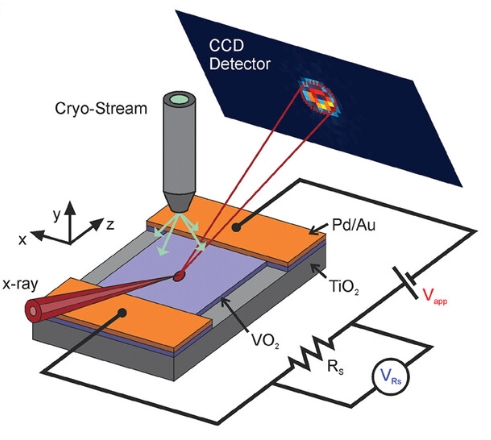
Source: Advanced Materials
This was a huge effort, as the study itself lasted more than 10 years and involved many research teams and a multidisciplinary approach.
“By bringing these experts together and pooling our understanding of the problem, we were able to go far beyond our individual scope of expertise and discover something new.” – Roman Engel-Herbert, director of the Paul Drude Institute for Solid State Electronics in Berlin
vanadium movements
Researchers first observed that vanadium dioxide swelled upward as it turned into metal. This was contrary to theoretical predictions that it would decline.
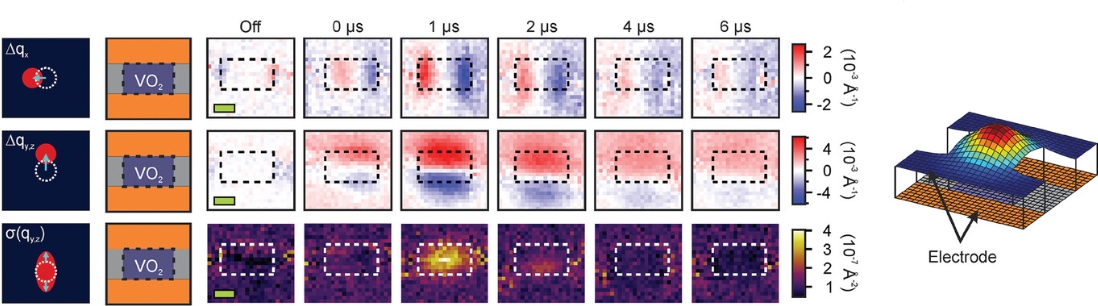
Source: Advanced Materials
They discovered that a previously unsuspected effect of the lack of oxygen atoms was responsible for the material’s swelling.
“These neutral oxygen vacancies contain a charge of two electrons, which they can release when the material changes from an insulator to a metal. “The remaining oxygen void now becomes charged and swells, causing the surprising swelling observed in the device.”
Pr. Venkatraman Gopalan, Pennsylvania State University
Unexpected activity of titanium substrate
A quasi-dogma in semiconductor manufacturing is that only the thin film of semiconductor material on the substrate is active when subjected to a current. The substrate itself is an electrically and mechanically passive material.
In this study, the researchers found that this is not the case for vanadium dioxide semiconductors.
Instead, titanium dioxide that was previously thought to be inert also swells, by the same mechanism involving a lack of oxygen atoms.
Furthermore, the top layer of titanium dioxide behaved like vanadium dioxide, also acting as a semiconductor.
This new discovery will be crucial in building prototypes of commercial vanadium dioxide semiconductors.
Applications
Better and faster semiconductors
Vanadium dioxide is considered a very promising material to take semiconductor technology to the next level, due to some fundamental characteristics:
- Insulator-to-metal conversion (IMT) occurs at an extreme speed of one trillionth of a second, paving the way for ultra-fast calculations.
- Vanadium dioxide has strongly correlated electronic effects. In simple terms, this means that repulsion between electrons cannot be ignored, as is currently done in silicon-based electronics.
- This, in turn, opens up possibilities for novel functionalities such as high-temperature superconductivity and enhanced magnetic properties.
Neuromorphic computing
The discovery of the positive feedback process due to vacancy ionization of missing oxygen atoms should further reduce the IMT time.
This has very important consequences, as it makes vanadium dioxide potentially the right material for a new type of stone called neuromorphic computing.
Neuromorphic computing is a method in which computing systems are inspired by the brains of living systems with neurons.
This differs from the neural networks currently used by AI and LLMs that attempt to mimic neurons, but are still based on classical silicon transistors and are primarily software-based machine learning.
So neuromorphic chips could learn at the hardware level. And instead of binary output (0 and 1), they would produce signal spikes.

Source: Technological objective
Thanks to its very rapid transition from insulator to metal, vanadium dioxide could be used with an active titanium dioxide substrate to create Mott neuron-like spiking oscillators capable of replicating biological neurons at the hardware level.
General description
Vanadium dioxide semiconductors, neuromorphic computing, and Mott neuron-like spiking oscillators are at the very edge of materials science and semiconductor design, likely at least a decade away from reaching commercial viability .
This decade’s period is exactly when we should expect silicon-based semiconductors to start failing to keep Moore’s Law valid.
There is nothing in Moore’s Law that says semiconductors must be based on silicon. It is rather an empirical observation that as long as there is demand for more powerful chips, researchers will continue to learn more about the physics of semiconductors at a smaller and smaller scale.
Considering that we are now studying vanadium and titanium dioxides, in real time and at the atomic level, it seems reasonable to expect that Moore’s law will hold and that materials like vanadium will be the next step in semiconductor design.
And of course, other innovative forms of computing could also help keep Moore’s Law going, such as photonics or quantum computing.
Advanced semiconductor companies
1. Intel
Intel is a giant in the semiconductor sector and has evolved over the years from an industry founder to a scientific and innovation leader, losing the top spot in manufacturing volume to companies like Taiwan’s TSMC.
Intel is a leader in neuromorphic computing, including through its 2 long pieces.

Source: Intel
He also created the Intel Neuromorphic Research Communityincluding Pennsylvania State University, involved in this recent vanadium dioxide research, as well as more than 75 other research groups.

Source: Intel
Intel is also very active in mimicking biological sense by replicating the way our brain works (itself a branch of neuromorphic computing), something we discuss later in our article.”Biomimetic olfactory chips: are artificial intelligence and electronic noses the next canary in a coal mine?“
In general, the investigation of Intel Lab is at the forefront of semiconductor innovation, including artificial intelligence, quantum computing, neuromorphic computing, etc. (we discuss Intel’s advances in quantum computing in our article “The current state of quantum computing“).
2.IBM

Another historic pioneer in computing, semiconductors and chip design, International Business Machines Corporation (IBM) He is also researching neuromorphic computing.
It is also developing SyNAPSE: Scalable and Energy-Efficient Neurosynaptic Computingsupported by the Defense Advanced Research Programs Agency (DARPA), to combine “nanoscience, neuroscience, and supercomputing to simulate and emulate the brain’s capabilities for sensation, perception, action, interaction, and cognition.”
It is also at the forefront of the development of quantum computers. For example, he developed his 127-qubit “Eagle” quantum computer, which was followed by a 433-qubit system known as “Osprey” and the 1,121-qubit “Condor” superconducting quantum processor.

Source: All about circuits
Along with Intel, IBM is among the companies most aggressively pushing new forms of computing technologies, such as quantum and neuromorphic computing, and is likely to benefit from advances made in understanding the fundamental atomic physics of materials such as carbon dioxide. of vanadium.
#Keeping #Moores #Law #active #substrates #neuromorphic #computing