


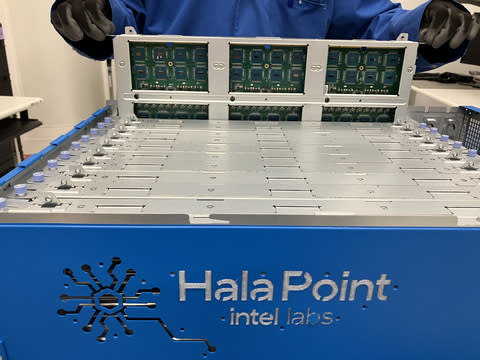
Hala Point, the industry’s first 1.15 billion neuron neuromorphic system, builds a path to more efficient and scalable AI.
SANTA CLARA, California, April 17, 2024–(BUSINESS WIRE)–What’s new: Intel announced today that it has built the world’s largest neuromorphic system. This large-scale neuromorphic system, codenamed Hala Point, was initially deployed at Sandia National Laboratories, uses Intel’s Loihi 2 processor, and aims to support research for future brain-inspired artificial intelligence (AI). and addresses challenges related to efficiency and sustainability. of current AI. Hala Point advances Intel’s first-generation large-scale research system, Pohoiki Springs, with architectural improvements to achieve more than 10x more neural capacity and up to 12x more performance.
“The computing cost of today’s AI models is increasing at an unsustainable rate. The industry needs fundamentally new approaches capable of scaling. That’s why we developed Hala Point, which combines the efficiency of deep learning with novel optimization and learning capabilities inspired by “We hope that research with Hala Point will advance the efficiency and adaptability of large-scale AI technology.”
–Mike Davies, director of the Neuromorphic Computing Laboratory at Intel Labs
What are you doing: Hala Point is the first large-scale neuromorphic system to demonstrate next-generation computational efficiencies in conventional AI workloads. Characterization shows that it can support up to 20 trillion operations per second, or 20 petaops, with efficiency exceeding 15 trillion operations per second per watt (TOPS/W) when running conventional deep neural networks. This rivals and exceeds the levels achieved by architectures based on graphics processing units (GPUs) and central processing units (CPUs). Hala Point’s unique capabilities could in the future enable real-time continuous learning for AI applications such as scientific and engineering problem solving, logistics, smart city infrastructure management, large language models (LLM) and AI agents.
How it will be used: Researchers at Sandia National Laboratories plan to use Hala Point for advanced brain-scale computing research. The organization will focus on solving scientific computing problems in device physics, computer architecture, computer science, and computer science.
“Working with Hala Point enhances our Sandia team’s ability to solve scientific and computational modeling problems. Conducting research with a system of this size will allow us to keep pace with the evolution of AI in fields ranging from commercial to defense and basic science,” said Craig Vineyard. , Hala Point team leader at Sandia National Laboratories.
Hala Point is currently a research prototype that will improve the capabilities of future commercial systems. Intel anticipates that such lessons will lead to practical advances, such as the ability of LLMs to continually learn from new data. These advances promise to significantly reduce the unsustainable training burden of widespread AI deployments.
Because it is important: Recent trends in scaling deep learning models to trillions of parameters have exposed enormous sustainability challenges in AI and highlighted the need for innovation at the lowest levels of hardware architecture. Neuromorphic computing is a fundamentally new approach that draws on insights from neuroscience that integrate memory and computation with highly granular parallelism to minimize data movement. In published results from this month’s International Conference on Acoustics, Speech and Signal Processing (ICASSP), Loihi 2 demonstrated orders of magnitude gains in the efficiency, speed and adaptability of emerging small-scale edge workloads.1.
Advancing its predecessor, Pohoiki Springs, with numerous improvements, Hala Point now brings neuromorphic performance and efficiency gains to conventional deep learning models, particularly those processing real-time workloads such as video, voice, and communications. wireless. For example, Ericsson Research is applying Loihi 2 to optimize the efficiency of telecom infrastructure, as highlighted at this year’s Mobile World Congress.
About Punto Hala: Loihi 2 neuromorphic processors, which form the foundation of Hala Point, apply brain-inspired computing principles such as asynchronous and event-based spiking neural networks (SNN), integrated memory and computing, and sparse and continually changing connections to achieve orders of -magnitude gains in power consumption and performance. Neurons communicate directly with each other rather than through memory, reducing overall energy consumption.
Hala Point includes 1,152 Loihi 2 processors produced on Intel process node 4 in a six-rack unit data center chassis the size of a microwave oven. The system supports up to 1.15 billion neurons and 128 billion synapses distributed across 140,544 neuromorphic processing cores, consuming a maximum of 2,600 watts of power. It also includes more than 2,300 x86 processors built in for auxiliary calculations.
Hala Point integrates processing, memory and communication channels into a massively parallelized fabric, providing a total of 16 petabytes per second (PB/s) of memory bandwidth, 3.5 PB/s of inter-core communication bandwidth and 5 terabytes per second (TB/s) of inter-chip communication bandwidth. The system can process more than 380 trillion 8-bit synapses and more than 240 trillion neural operations per second.
Applied to neural network models with bioinspired spikes, the system can run its full capacity of 1.15 billion neurons 20 times faster than a human brain and up to 200 times faster at lower capacity. While Hala Point is not intended for neuroscience modeling, its neural capacity is roughly equivalent to that of an owl’s brain or a capuchin monkey’s cortex.
Loihi-based systems can perform AI inference and solve optimization problems using 100 times less power at speeds up to 50 times faster than conventional CPU and GPU architectures.1. By exploiting sparse connectivity of up to 10:1 and event-driven activity, early results at Hala Point show that the system can achieve deep neural network efficiencies of up to 15 TOPS/W.2 without the need to collect input data in batches, a common optimization for GPUs that significantly delays the processing of data arriving in real time, such as video from cameras. While still under investigation, future neuromorphic LLMs capable of continuous learning could generate gigawatt-hours of energy savings by eliminating the need for periodic retraining with ever-growing data sets.
Whats Next: The delivery of Hala Point to Sandia National Labs marks the first deployment of a new family of large-scale neuromorphic research systems that Intel plans to share with its research collaborators. Further development will allow neuromorphic computing applications to overcome power and latency limitations that limit real-time, real-world implementation of AI capabilities.
Together with an ecosystem of more than 200 members of the Intel Neuromorphic Research Community (INRC), including leading academic groups, government laboratories, research institutions and companies around the world, Intel is working to push the boundaries of inspired AI. in the brain and advance this technology based on research prototypes. to industry-leading commercial products in the coming years.
More context: Intel Labs | Hala Point: intro video and photos
About Intel
Intel (Nasdaq: INTC) is an industry leader creating world-changing technology that enables global progress and enriches lives. Inspired by Moore’s Law, we continually work to advance semiconductor design and manufacturing to help address our customers’ biggest challenges. By embedding intelligence across the cloud, network, edge, and every type of computing device, we unlock the potential of data to improve business and society. To learn more about Intel innovations, visit newsroom.intel.com and intel.com.
1 See “Efficient Video and Audio Processing with Loihi 2”, International Conference on Acoustics, Speech and Signal Processing, April 2024, and “Advancing Neuromorphic Computing with Loihi: Survey of Results and Outlook”, IEEE Proceedings, 2021.
2 Characterization performed with a multilayer perceptron (MLP) network with 14,784 layers, 2048 neurons per layer, 8-bit weights stimulated with random noise. Hala Point’s implementation of the MLP network reduces to 10:1 sparsity with sigma-delta neuron models providing 10 percent firing rates. Results as of testing conducted in April 2024. Results may vary.
© Intel Corporation. Intel, the Intel logo, and other Intel marks are trademarks of Intel Corporation or its subsidiaries. Other names and brands may be claimed as the property of others.
View the source version on businesswire.com: https://www.businesswire.com/news/home/20240417915986/en/
Contacts
Laura Stadler
1-619-346-1170
laura.stadler@intel.com
#Intel #builds #worlds #largest #neuromorphic #system #enable #sustainable