
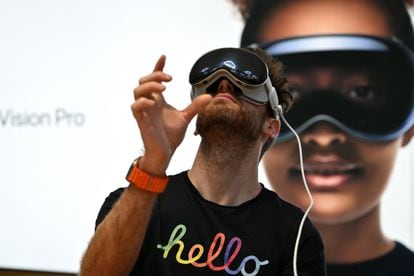
More than 20 years have passed since the launch of Minority report (2002), Steven Spielberg’s film adaptation of a futuristic short story by Philip K. Dick, which became a major box office success. In the film, Tom Cruise interacts with a computer hologram, opening and closing tabs and typing without the need for a keyboard or mouse. The film is set in the year 2054 and, for many, was his first contact with what augmented reality (AR) could mean for everyday life. At the time, it was a dystopian vision. Now 2024 (much earlier than the movie predicted) has begun with the launch of Apple’s Vision Pro augmented reality glasses, and images and videos have recorded people absorbed in their world while traveling on the subway or crossing a crossing. signposted pedestrians.
This has reopened a debate that made headlines in 2016 after the launch of the revolutionary video game Pokémon Go, which reached 232 million active users the year it debuted. The augmented reality game, which superimposes virtual elements on reality – unlike virtual reality, which immerses users in a totally virtual environment – consisted of hunting Pokémon in the most unusual places in a city. The game was banned in countries such as China and Iran, which considered it a threat to public safety. In fact, so many people were injured trying to locate the creatures that the number of deaths began to be tracked. To date, 24 people have died and 62 have been injured. It’s been eight years between the launch of Pokémon Go and Apple’s Vision Pro glasses, but have we learned anything?
According to David Lindlbauer, a professor at the Institute of Human-Computer Interaction at Carnegie Mellon University, where he directs the Augmented Reality Laboratory, this technology has not yet been integrated into society. The key to its advancement is the use to which it is put, he explains. “Escapism does not come from the medium of interaction. [smartphone, television]but of the content [games, social networks]. AR gives us the opportunity to improve our lives by allowing us to do things that may be difficult, such as communicating with loved ones who are far away; share content in a fun way; be productive, but less stressed, or learn new things more easily,” says Lindlbauer via email.
But what does the data say? A research team at Stanford University published the first study on AR experiences after spending hours wearing Vision Pro glasses in public and private. One of the most significant findings of the article, titled Seeing the world through digital prisms: Psychological implications of using walk-through video in mixed reality. — is that hand-eye coordination takes 43% longer with digital glasses than without them, and that tasks like eating or pressing buttons are especially difficult due to the difference in spatial perception and size. “While the technology improves with each new headset and software update, the pass-through falls far short of the human visual system: they are slower, grainier and more distorted, and cut off a large portion of the field of view,” it reads in the study.
But perhaps most alarming is the social impact of technology and the discovery that “people in the real world just felt less real.” The researchers emphasize how uncomfortable they felt interacting with other people while wearing the AR glasses. “Being in public can sometimes feel more like watching television than interacting face-to-face,” the study explains.
The study’s principal investigator, Jeremy Bailenson, director and founding member of the Virtual Human Interactions Laboratory (VHIL) at Stanford University, is clear about what the results mean. “AR should not be used all day, or even every day. “His strength has always been in his ability to give us special experiences, not continuous experiences,” he explains by email. According to Bailenson, users should not check email or watch movies with AR glasses. “A framework has been developed in my lab over the past few decades. Through hundreds of studies, we have learned that immersive media is best reserved for experiences that in the real world would be ‘dangerous,’ ‘impossible,’ ‘counterproductive,’ or ‘expensive.’” Train firefighters, rehabilitate stroke victims, learn art history. through museums, and traveling in time to understand climate change are some examples of these experiences.
Unlike virtual reality, which can cause social disconnection, augmented reality can offer benefits without causing social isolation. Users remain in the physical world at all times. That’s the argument of Apple CEO Tim Cook, who says he’s AR’s number one fan. He has even gone so far as to predict that: “A “A significant portion of the population in developed countries, and eventually all countries, will have AR experiences every day, almost like eating three meals a day.” Cook has a great interest in this result since he is betting everything on AR, trusting that this technology will complement or even replace the smartphone and the computer, giving users greater connectivity and productivity and reducing technological distractions.
A study carried out by the American consulting firm FinancesOnline indicates that AR could have a great impact on education and healthcare, as well as the video game industry. Technology, for example, could be used to promote mental health: both to diagnose mental states through facial expression (depression, anxiety…) and to carry out treatments, such as providing images or sounds that can help cheer up patients. users. However, according to Lindlbauer, more improvements are needed in AR hardware (it needs to be lighter, with longer battery life and better ability to see others’ faces) and software (context understanding, connectivity, privacy and security).
Those reluctant to try Vision Pro in everyday life can try more gradual approaches to AR, such as the Ray-Ban Meta smart glasses, which can take photos and record videos of what is being seen. The devices feature a microphone that allows users to talk on the phone and speakers that play music. Additionally, users can use Meta AI, a conversation assistant that can help with tasks like choosing what to wear. This is a less intrusive approach to augmented reality, especially when it comes to sound.
However, privacy remains one of the biggest problems, due to the threat of a possible leak of data stored by the user. “The lack of standards in XR [extended reality, the next step after augmented reality] threatens to create a fragmented surveillance society that does not serve humanity. What we need is a sustainable technological society,” Steve Mann, professor of computer engineering at the University of Toronto, says by email. “XR technologies have the potential to benefit humanity, but unfortunately, both Vision Pro and Meta Quest 3 are a kind of partnership of spectacular products that lack interoperability,” continues Mann, who is also the inventor of several AR devices, the author. of more than 200 articles and patent holder.
What we know is that AR is here to stay. According to Statista, the number of active users has quadrupled, from 400 million in 2019 to 1.73 billion in 2024. Until more complete and robust regulations are defined, it is advisable to approach this technology with caution.
Enroll in our weekly newsletter for more news coverage in English from EL PAÍS USA Edition
#Augmented #reality #important #invention #pure #distraction